
If you’re a woman, chances are you’ve been told at some point that your symptoms are caused by your “hormones.”
But what does that actually mean, and more importantly, what are you supposed to do about it?
Today, we’re pulling back the curtain so you can start seeing your hormones through a different lens. Not a scary one. An empowering one.
Information is only helpful when it doesn’t add more stress to your plate. So before we dive in – take a breath. 🌿
Are These Symptoms Familiar?
Many women come to us dealing with one or more of the following:
- PMS
- Brain fog
- Unexplained or stubborn weight gain
- Hair loss
- Mood swings
- Low libido
- Chronic fatigue
Here’s the key takeaway: if you go straight to “fixing your hormones,” you may never get full resolution.
Your Hormones Are Not the Problem
Most of the time, your hormones themselves aren’t the issue. The real problem is a breakdown in balance, communication, and clearance within the body.
Once you understand that distinction, everything starts to make more sense.
Hormones dictate every single function in the body – most women have heard of estrogen and progesterone, but there are many more at play. Today, let’s focus on estrogen, because when it’s out of balance, it can quietly wreak havoc on your quality of life.
What Estrogen Actually Does
Estrogen is far more than a reproductive hormone. It plays a critical role in:
- Brain and nervous system function
- Bone strength
- Heart health
- Metabolism and insulin sensitivity
- Tissue hydration
- Hormone signaling throughout the body
It’s vital – but problems start when it isn’t properly regulated, metabolized, and cleared.
When Estrogen Becomes a Problem
When estrogen rises beyond healthy levels often called “estrogen dominance” symptoms can include:
- Headaches and migraines
- Severe PMS
- Bloating
- Fatigue
- Excessive bleeding
- Increased risk of certain cancers
What “Estrogen Dominance” Really Means
This term gets used loosely, but there are actually two very different scenarios:
1. Absolute Estrogen Excess
Estrogen levels are genuinely elevated on labs.
2. Relative Estrogen Dominance (more common)
Estrogen is normal – or even low – but progesterone is too low to balance it out.
This distinction is especially important for women dealing with PCOS, endometriosis, or perimenopause. In many of these cases, the issue isn’t too much estrogen – it’s not enough progesterone.
The Missing Piece: Ovulation
Ovulation is not just about fertility. Let that sink in.
Ovulation is how your body produces progesterone – the hormone responsible for:
- Calming the nervous system
- Supporting deep, restorative sleep
- Stabilizing mood
- Balancing estrogen
- Supporting conception and pregnancy
No ovulation = no progesterone = imbalance. It really is that foundational.
Already in menopause and not ovulating? This still applies to you – especially if bio-identical hormones haven’t delivered the results you were hoping for.
Why Stress Quietly Disrupts Everything
Your brain is constantly running one background process: “Am I safe?”
When the answer is no — due to chronic stress, poor sleep, gut imbalances, or unresolved trauma – your body shifts into survival mode:
- Ovulation becomes inconsistent or stops
- Progesterone drops
- Thyroid function slows
- Blood sugar becomes erratic
This isn’t a mindset issue or a personality flaw. It’s your physiology responding to your environment.
The Metabolic Connection
Hormone imbalance is often metabolic first – before it ever shows up as a hormonal symptom.
Insulin resistance can:
- Increase fat storage
- Drive up estrogen production
- Suppress ovulation
- Lower progesterone
This is why PCOS, at its root, is a metabolic condition – not just a hormonal one. Metabolism drives hormones, not the other way around.
The Gut + Liver Connection
Your body doesn’t just make hormones – it has to clear them too. That clearance happens through:
- The liver (detoxification pathways)
- The gut (elimination)
When this system is disrupted, estrogen gets recirculated, inflammation increases, and symptoms persist – no matter how many supplements you take.
Gut health isn’t optional. It’s foundational. 🌱
Quick win: Prioritize vegetables, quality protein, and healthy fats. This trio supports your gut, liver, blood sugar, and hormones all at once.
What Actually Works (Clinically)
Balance doesn’t come from “detoxing harder.” It comes from supporting the systems that regulate your hormones:
- Blood sugar stability
- Gut health
- Liver function
- Stress and nervous system regulation
- Adequate protein and fiber
- Reducing toxin exposure
This is a systems-based approach – not a quick fix. And it’s what actually creates lasting results.
The Truth Most Women Need to Hear
Your body is not broken. Your hormones are not the enemy. Your body is adapting to its environment.
Your job is to listen and to give it the support it needs to find balance again. A simple starting point:
- ✅ Rest – prioritize sleep, reading, or meditation
- ✅ Reduce inflammation – cut back on sugar and processed foods
- ✅ Feel safe – surround yourself with people who truly see and support you
- ✅ Eat well – vegetables, responsibly-raised protein, and healthy fats
- ✅ Go slow – rushing and stress send the “I’m not safe” signal, which is the opposite of balance
Test, Don’t Guess
For some women, education alone is enough to create real change. For others, especially those with persistent symptoms, testing provides the clarity needed to actually move forward.
Testing can reveal:
- Hormone patterns
- Blood sugar and insulin levels
- Gut health markers and estrogen clearance
It moves you from passive bystander to empowered action-taker. And for every imbalanced marker, there’s a targeted protocol to address it.
If you’re doing everything “right” and still not gaining traction – testing may be your missing link.
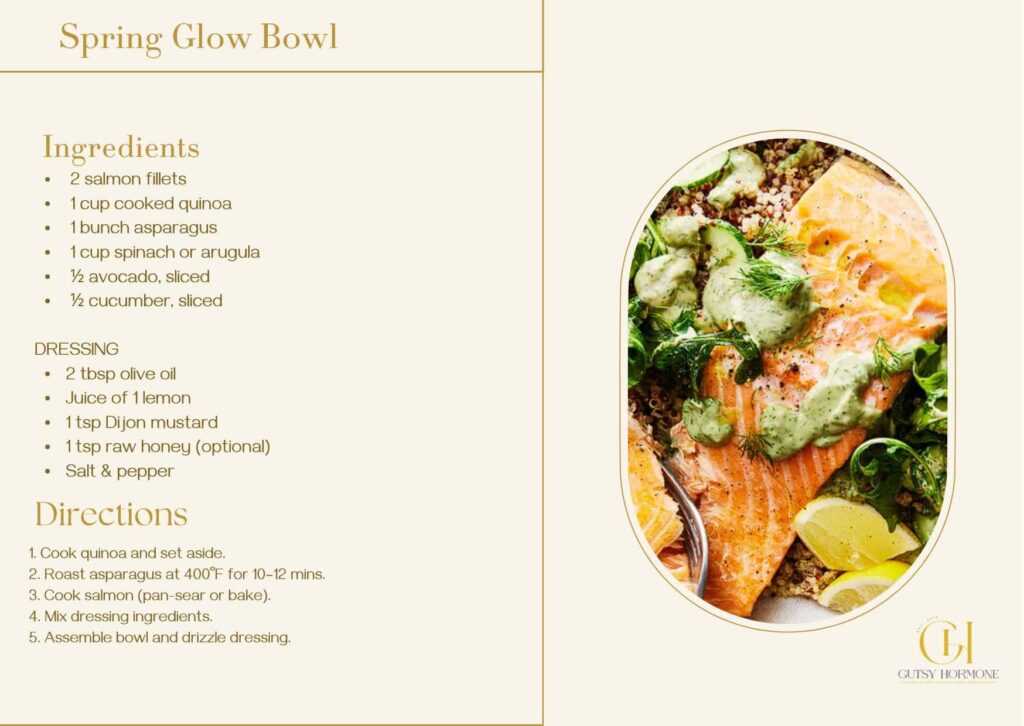
Recipe of the Month: Spring Glow Bowl
Spring is the perfect time to reset your plate. This Spring Glow Bowl is light, nourishing, and designed to support your gut, balance your hormones, and keep your blood sugar steady without sacrificing flavor.
Simple ingredients. Real nourishment. The kind of meal your body actually thanks you for.
Ingredients
Bowl
- 2 salmon fillets
- 1 cup cooked quinoa
- 1 bunch asparagus
- 1 cup spinach or arugula
- ½ avocado, sliced
- ½ cucumber, sliced
Dressing
- 2 tbsp olive oil
- Juice of 1 lemon
- 1 tsp Dijon mustard
- 1 tsp raw honey (optional)
- Salt & pepper to taste
Directions
- Cook quinoa and set aside.
- Roast asparagus at 400°F for 10–12 minutes.
- Cook salmon by pan-searing or baking until done.
- Whisk together all dressing ingredients.
- Assemble bowl and drizzle dressing over everything. Enjoy!
Also Worth Knowing: What You Put ON Your Body Matters Too
If you’re being more intentional about what you eat, it’s worth thinking about what you put on your skin as well. Our skin absorbs what we put on it and that includes ingredients that can disrupt the very hormones we’re working to balance.
Counter’s Concealers offer a cleaner swap that aligns with a hormone-supportive lifestyle. If you’re looking to simplify your beauty routine without compromising on quality, check it out here.